Sustainability Without Compromise: The Euca Story
Euca Townhomes in Modbury was never intended to be a “green showcase” project. Instead, the vision was far more practical – to prove that high-quality sustainability outcomes could be delivered in affordable housing without compromising liveability, design or feasibility.
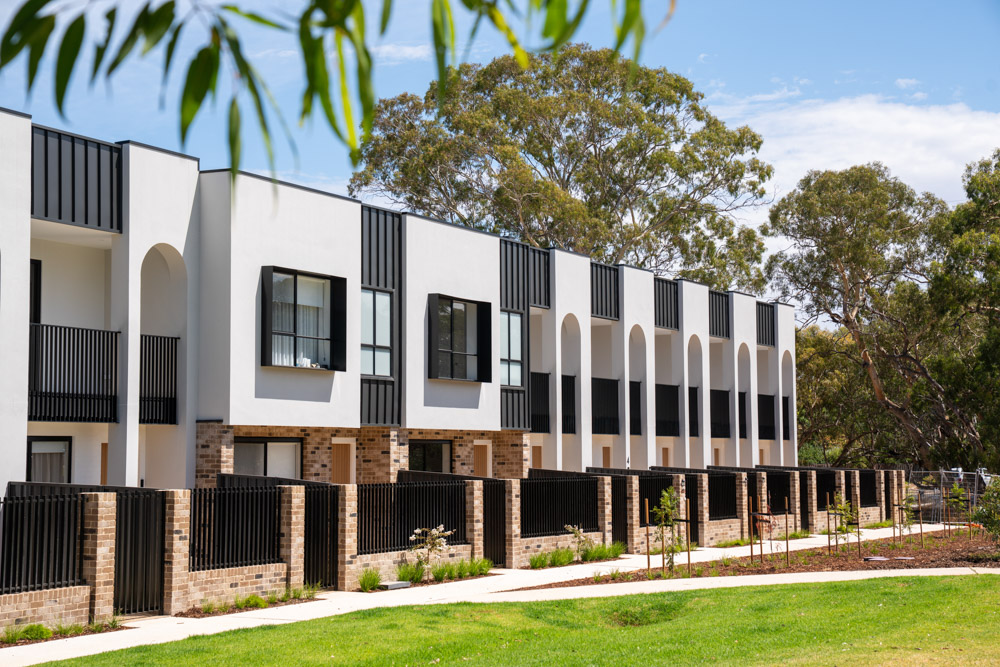
Delivered by Kolabb in partnership with the City of Tea Tree Gully and built by Centina, the boutique community of 25 architecturally designed townhomes transformed previously underutilised land into a new residential development centred around sustainability, liveability and community connection.
Located adjacent to a newly delivered public park, the two and three-bedroom homes achieved an average 7.5-Star NatHERS energy rating and incorporated next-generation sustainability initiatives as standard – including passive solar design, high-performance building envelopes, efficient building services, renewable energy systems and rigorous as-built performance testing.
For Josh Mollison, Managing Director of sustainability consultancy LBS, the project stood apart because sustainability conversations began at the concept stage – not after key decisions had already been made.
“Late in 2022, I remember sitting in a café with Karl from Kolabb talking through the vision for Euca, and what struck me immediately was that sustainability wasn’t being treated as a sales pitch or a greenwashing exercise,” Mollison said.
“There was a genuine desire to deliver high-quality, affordable homes that performed well environmentally and financially for residents. That mindset shaped everything that followed.”
Mollison said the project team consistently referred back to what became known internally as the “Goldilocks principle” – balancing sustainability ambition with commercial reality.
“We wanted to push for strong sustainability outcomes, but we also knew we were delivering affordable housing,” he said.
“So the question became: where do we spend money to create the biggest impact? We were constantly looking for that sweet spot where build cost and sustainability outcomes were ‘just right’.”
From those early discussions, LBS developed a sustainability brief built around three key targets: achieving at least a 7.5-Star NatHERS rating, delivering net-zero operational greenhouse gas emissions, and undertaking blower-door testing at completion to verify the homes performed as designed.
The consultancy then worked closely with the broader project team through extensive energy modelling, sensitivity testing and design refinement.
“We spent a lot of time testing different scenarios and optimising the design,” Mollison explained.
“The final outcome achieved operational carbon neutrality largely through the strength of the building façade and the incorporation of on-site renewables. For residents, that means lower energy bills and significantly improved comfort levels year-round.”
According to LBS, the emissions savings compared to standard housing are substantial – roughly equivalent to removing approximately 458,000 kilometres of vehicle travel annually.
One of the most technically significant elements of the project was the inclusion of blower-door testing, which remains relatively uncommon in mainstream residential construction in Australia.
The testing process measures the airtightness of a building by sealing the home and using specialist equipment to identify uncontrolled air leakage points. Airtightness plays a major role in thermal comfort, energy efficiency and overall building performance.
“Blower-door testing is really about accountability,” Mollison said.
“It’s one thing to model sustainability outcomes during design, but the real test is whether the building actually performs that way once constructed.”
“If there are gaps in the building envelope allowing uncontrolled air movement, it compromises efficiency, comfort and energy performance. The testing gives us measurable proof that what was designed has actually been delivered.”
For Mollison, revisiting the project during the final testing phase became something of a full-circle moment.
“My favourite part wasn’t even the technical detailing – although there’s plenty of that I enjoy,” he said.
“It was seeing how the homes connected directly into the park and public open space. That connection creates openness, calm and community in a way you don’t often see in urban infill developments.”
The park component, also delivered by Kolabb and Centina, includes landscaped green space, mature tree planting, a playground, pathways and open lawn areas designed to benefit both residents and the broader community.
While Euca may not be the largest or most headline-grabbing sustainability project in the country, Mollison believes its significance lies in demonstrating that sustainable housing delivery can become normal practice rather than a premium niche offering.
“The vision for Euca was simple – make affordable sustainability achievable and practical,” he said.
“To me, projects like this matter just as much as the landmark sustainability towers because they bring better-performing homes to more people.”
As the housing industry continues grappling with affordability, energy costs and emissions reduction targets, Euca offers an example of how sustainability outcomes can be embedded into mainstream housing delivery through early collaboration, smart design decisions and measurable performance verification.